Are you favouring eating on one side of your mouth more than the other after you lost your tooth or teeth?
Should I have Dental Implants? Ask yourself these simple questions:
Are you having the trouble with recurrent sore spots from your loose denture?
Are you worrying that your denture might be flying of your mouth in front of the public when you sneeze or cough?
Are you feeling embarrassed or reluctant to smile because of your missing tooth or teeth?
Are you having difficulty in your speech due to the presence of your denture or the absence of your teeth?
Did you lose your tooth or teeth due to gum disease, decay or perhaps an accident ?
Was your tooth missing from birth?
If your answer is Yes to any of the above questions
Dental Implants maybe your answer.
WHAT ARE DENTAL IMPLANTS
Dental implants have been around over 50 years and now become a new standard of care.
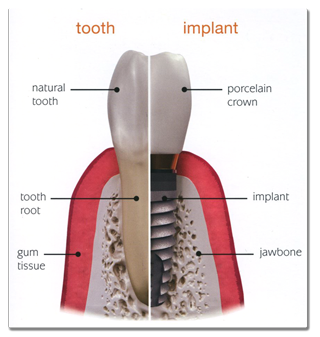
Dental Implants in Canberra have certainly picked up this trend in recent years. Dental implants are the closest imitation of mother natures’ work in creating a tooth. The missing roots are replaced by a titanium screw positioned in the jawbone.
In the past, it would take 6 to 12 months for the implants to be integrated into the jawbone (osseointegration). Significant improvement in various types of the implant surface has helped to reduce the integration time to 10-12 weeks.
The dental implants provide support for the crown(s) on top and replace a missing tooth or teeth. For patients who wear dentures, the implants serve as anchors for the dentures. Metal housings will be fitted at the base of the dentures. They will click over the implant heads to provide stability for your denture.
WHAT WILL HAPPEN WHEN I CHOOSE NOT TO REPLACE MY MISSING TOOTH?
When lack of stimulation from the roots, the jawbone shrinks just like muscle wasting when one is sick and bed-ridden for some time.
The teeth adjacent and opposing to the missing tooth will move and tilt towards the gap. Spaces between your teeth are widened and favour food trap, decay and gum disease.
The opposing tooth or teeth look longer due to super-eruption. Your bite plane could change.
All these events slowly happen and they can change your appearance and make you look older.
AM I A CANDIDATE FOR DENTAL IMPLANTS?
Most adults and some adolescents whose facial structures have matured can have dental implants.
Patients who are prone to infections such as patients with poorly-controlled diabetes, immuno-compromised conditions so as smokers, can have much higher risk of implant failure.
These issues will be discussed at the consultation visit.
WHAT DOES THE IMPLANT PROCESS INVOLVE?
1. ASSESSMENT AND TREATMENT PLANNING
The dentist will go through the details of your general health including the medications you are taking and assess the status of your dental health.
X-rays, impressions of your teeth and the bone scan of the implant site will be included in the assessment.
2. BONE GRAFT OR SOCKET GRAFT
If the volume and the quality of the bone receiving the implant is not adequate for optimal implant placement, a bone graft maybe necessary.
It could take three to six months for the site to mature before the implant can be inserted.
Specialist dentist could be involved in this step.
3. IMPLANT PLACEMENT
The procedure will be carried out under local anaesthetics. If you feel nervous about the appointment, it maybe helpful for you to have some form of oral sedation medication, prescribed by your doctor.
You will need someone to drive you to the appointment and take you home afterwards. It is essential that you follow our instructions on taking antibiotics and pain relief. Generally, you should be comfortable enough to return to work the next day.
You will have a form of temporary restoration while you wait for the implant to integrate. The method of temporary replacement of your missing tooth or teeth will be discussed with you at the consultation visit.
The healing process mostly takes three months.
FINAL RESTORATION AND CARE FOR THE IMPLANT
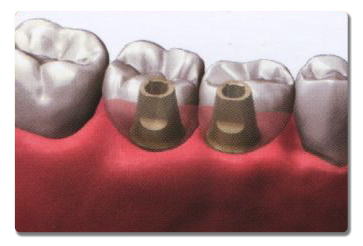
Implant-retained crowns are restorations whereby a titanium screw is placed into the jaw bone to replace a missing tooth root, and then a crown is placed on top. In the case of multiple missing teeth, more than one implant can be placed, and multiple crowns or a bridge put on top.
Implants provide a solution for one or many missing teeth and once again, you will be able to smile widely and enjoy whatever food you desire. A dental implant with a crown is the only way to replace a missing tooth that will then look, feel and function like your natural tooth.
Bridges close a gap caused by one or more missing teeth. They consist of an artificial tooth being anchored to the adjacent natural teeth on each side of the gap.
Bridges are either made entirely from porcelain, or from porcelain bonded to a metal substructure.
MINI DENTAL IMPLANTS MDI, WHAT ARE THEY AND HOW ARE THEY DIFFERENT TO THE CONVENTIONAL IMPLANTS?
RISKS AND COMPLICATIONS ASSOCIATED WITH DENTAL IMPLANTS
Include but not limited to:
- pain, swelling, post-op infection
- Parathesia or anaesthesia of tongue and lips
- Failures of osseous integration
- Fracture, displacement of implants and or prosthetic components
- Premature bone loss, periimplantitis, mucositis
Patient’s status of general and dental health, treatment planning and maintenance commitment can contribute to success or failure of a case.
Consultation and second opinion are recommended.